May Kasahara’s engulfing inner core
The Wind-Up Bird ChronicleMay Kasahara’s engulfing inner core is the name she gives to an unstable force within her, one that can grow beyond her ability to contain it and threaten to break her apart. The image joins bodily sensation to a crisis of identity: in the well’s darkness, May feels the force feeding and expanding, while in daylight it remains held inside. Her account connects that experience to her risky attempts to make another person feel what she cannot get them to understand.
A bodily force within
May describes every person as having a different thing at the core of existence, a kind of heat source that runs them from within. Her own sometimes swells or shrinks and shakes her up. She wants to communicate that experience to someone else, but suspects that people either do not listen or do not understand what she is trying to explain. When she cannot make the feeling legible in words, she says, she gets worked up and does crazy things. The core is thus both intensely personal and a barrier between May and other people: it is what she most wants them to know, yet it resists translation into shared language.
She gives the force a more concrete shape when describing her confinement in the well: a small, gooshy white thing, like a lump of fat, growing inside her body. The image is deliberately visceral rather than diagnostic. May does not present it as an illness with a settled explanation; she describes a felt presence whose growth threatens to split its container. The comparison to roots expanding inside a pot makes the danger a contest between an enclosing self and something that may outgrow it.
Darkness and the well
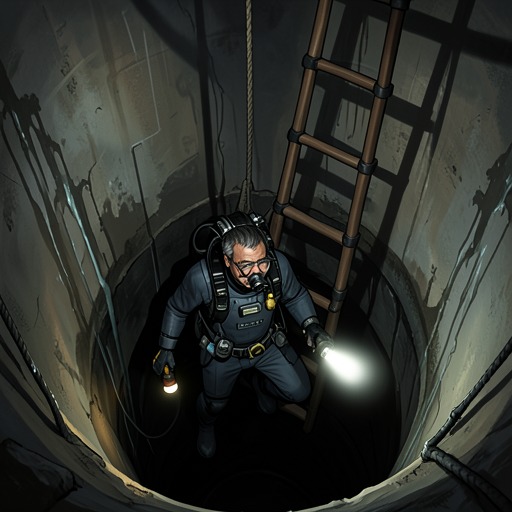
May says that she was not initially terrified by the well’s darkness. After several hours, however, she began to know less and less who she was. The change was not simply fear of being trapped: sitting still in the dark, she felt the thing inside her getting larger, as if it would eventually break her apart. She believed it absorbed a special kind of nourishment in darkness and began growing with frightening speed, while remaining comparatively contained under the sun. Darkness therefore becomes, in her account, an active condition of the experience rather than an empty backdrop.
The episode reverses the ordinary expectation that an unseen interior is private and inert. May experiences something inside her as having its own appetite and momentum, taking her over and eating her up. Her description makes the boundaries between person and inner presence unstable: she calls it part of herself, yet also speaks of it as something that acts upon and consumes her. The well’s confinement gives that division a physical setting, while the contrast with sunlight marks how sharply her experience changes with place.
Fear made into an encounter
After taking the rope ladder away and leaving Toru Okada below, May admits that she wanted him to experience something like what she had felt. She says that she had not been especially frightened at first, but became terrified when she sensed the inner thing growing beyond her control. She wanted Toru to hear the sound of it chewing him up. Her act turns an inward, nearly incommunicable experience into an imposed encounter: she cannot simply explain the force and be sure it is understood, so she makes another person undergo the well’s darkness.
May later connects such boundary-testing to other dangerous behavior, including putting her hands over the eyes of a boy driving a motorcycle. She says she did not mean to kill him, although she did kill him; covering his eyes and tickling him had been part of what she describes as a game of pushing limits. Her account places the removal of Toru’s ladder within that established pattern of risk, without making the acts equivalent. In both cases, testing a limit becomes a way to approach or expose what she cannot otherwise reach.
A force that cannot save her
May says she wanted to draw the gooshy thing out of herself and crush it, using good bait and pushing the limits far enough to trick it into emerging. The ambition is not a claim that she has succeeded: she insists that she has not been saved and that nobody can save her at that point. To her, the world looks empty and false, while the inner presence is the only thing that does not seem fake. The core is therefore at once a source of terror and the remaining certainty in a world she experiences as unreal.
The image resonates with the novel’s broader concern with perception and the instability of reality, but remains distinctly May’s account rather than a settled explanation of the book’s other mysteries. The narration repeatedly places people in spaces where ordinary orientation weakens: the alley is a passage narrowed and sealed until it no longer leads through, and the well’s darkness makes it difficult to hold onto visible shapes or familiar understandings. When Toru Okada later returns to the neighborhood after emerging from the well, he senses that a new reality has replaced the old one. These spaces echo May’s description of a self whose inner boundary no longer feels secure, without proving that her “thing” and the novel’s other uncanny phenomena are identical.
Recurrence and significance
The account takes shape through Toru’s experience of darkness and memory as well as through May’s later words. While sitting in the well, Toru finds that his memories have acquired an unusual vividness and recalls first meeting her in a university hospital waiting room, where she was attending her mother. The sequence links the well not only to May’s later explanation but also to the novel’s recurring movement from physical enclosure into memory and uncertain perception. What May says cannot be reduced to Toru’s recollection, yet the structure makes the dark well a place in which buried experience becomes newly forceful.
The surrounding settings also establish a contrast between familiarity and estrangement. Toru and Kumiko Okada had accepted a house in Setagaya from Toru’s uncle at nominal rent, agreeing to leave on three months’ notice; its small yard nonetheless gave them a sense of belonging to a real household. The narrow alley near their home had, by contrast, been sealed at both ends as neighboring houses filled the lots around it, leaving it an abandoned, overgrown buffer rather than a usable route. On one gray, rainy visit, Toru notices that the alley seems to absorb not only sound but perception. After his time in the well, he again finds the neighborhood hushed and unfamiliar, as though its former reality had been displaced. These details make the “inner core” legible within a world where surroundings can alter how secure, continuous, or real the self feels.
The final image of the place strips away the architecture that had held these experiences. In winter, Toru looks through gaps in a high plank fence at the cleared site of the former Miyawaki house: the well, trees, paving stones, bird sculpture, and house are gone, leaving compacted earth and scattered weeds. May is no longer at her house either. The physical setting that had enclosed the well and made the alley a route to it has disappeared, while May’s account of an inward force remains unresolved. Its significance lies in that unresolved pressure: the core is something she feels as real but cannot master, explain, or make another person fully share.